
As a result of irrigation and fertigation, fertilizers may accumulate in the pots. High electrical conductivity, EC and acidity, pH cause stress to the berry. Therefore, we must pay attention to its increase. This is carried out by both series I) sensors and EC and pH measurements of the pot discharge in the drainage water.
As we mentioned, in the rainy conditions of Western Georgia, not only does fertilizer not accumulate in the pots, but it is washed away by rain. We practically observe this with Teros 12 sensors placed in pots in projects and in test pots.
But in greenhouses, the processes of washing away by rain do not occur and the use of these sensors is relevant. If EC and pH exceed critical values, it is necessary to wash it with irrigation water.
For this, a vessel is placed below the pot to be monitored, to which a drain tap is made. It contains conductivity, EC and acidity, pH sensors. For measurements to be performed correctly, the garden operator must empty this container every day by opening the tap.
Many companies produce devices for measuring conductivity, EC and acidity, pH in water. They look like this. They need a so-called conductivity, EC and acidity, pH transmitter, a device that converts their signals into an electrical signal in the range of 0-24 milliamperes. Only then does the reading device perceive it.
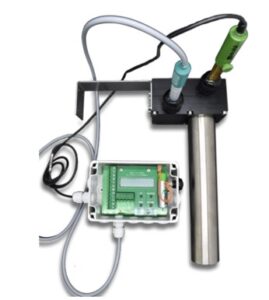
You should pay attention to the following:
The quality of the sensors?
How many such sensors does the transmitter connect to
How many such sensors does the reader read?
How many such sensor data can the main controller receive?
Of course, the budget
All this is necessary so that you do not overpay for a less expensive configuration. We will consult with you on this issue.