
Below is a clear, professional English translation of your Georgian text.
The technical meaning and structure are preserved, with smooth, natural wording suitable for technical documentation or a website.
Blueberry Production in Pots under the High-Rainfall Climate of Western Georgia
Growing blueberries in pots is a highly profitable business. The main reason is that the farmer has full control over the production process, yield quantity, and fruit quality, and is therefore less dependent on environmental conditions.
When producing blueberries in pots, the management of the following factors is critically important:
- Water content in the root zone
In the regions of Western Georgia, blueberries are mostly grown on heavy soils. Under conditions of excessive soil moisture (high VWC %), plants experience stress and root diseases develop, which significantly reduces yield. - Proper plant nutrition
- Frost protection
- Wind protection
The first and second issues are effectively solved by growing blueberries in pots using the technology described below. The high-rainfall climate of Western Georgia significantly alters globally accepted approaches and imposes specific requirements on both substrate selection and the management of irrigation and fertigation systems.
Irrigation System Design and Automatic / Semi-Automatic Control
Rule 1
The application rate of a drip irrigation system (mm/h) must not exceed the water transmission capacity (infiltration rate) of the substrate.
Example:
Assume a pot with a diameter of 40 cm, equipped with four drippers of 1.6 L/h each. In this case, the water application rate to the pot is approximately 50 mm/h.
This value must be lower than the substrate’s infiltration rate; otherwise, waterlogging of the upper substrate layers will occur, leading to oxygen deficiency and the development of root diseases.

Figure 1. Green algae formation in pots as a result of waterlogging.
Physical Nature of the Substrate
A substrate is a porous medium in which plant roots are located inside pores filled with water and nutrient solution. Research shows that the water transmission capacity of a substrate strongly depends on its moisture content.
When the substrate is fully saturated with water (so-called maximum container water capacity), the infiltration rate is very high—several hundred or even thousands of mm/h (Table 1, Column 2).
Table 1. Hydraulic conductivity of substrates (infiltration rate)
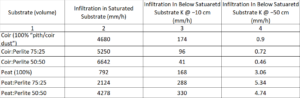
When substrate moisture slightly drops below saturation (water potential −10 cm), the infiltration rate decreases significantly (Column 3).
When moisture is far below saturation (water potential −50 cm), infiltration decreases sharply and may be as low as 0.9–5 mm/h, causing water to accumulate on the surface of the pot.
Irrigation management must prevent the substrate from reaching this condition.
Rule 2
Water content in the pot must remain between the saturation point and the wilting point.
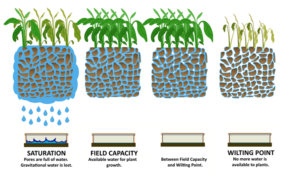
Figure 2.
Substrate water content is monitored using special sensors designed for substrates. Sensors intended for mineral soils are not suitable for use in substrates due to their porous nature.
Detailed information about the sensor can be found here.
Rule 3
It is essential to know the substrate’s:
- Moisture content at saturation
- Moisture content at the wilting point
If these values are unknown, they can be determined experimentally. ProAgro can assist with this process.
Irrigation Control Algorithm
As an example, consider a substrate and pot with defined parameters.
00000
Based on continuous monitoring of substrate water content (%) using sensors, the following irrigation regimes are applied.
Rule 4. Irrigation Management
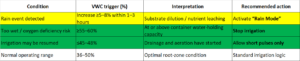
Table 2.
The yellow-marked regimes are especially important for the high-rainfall climate of Western Georgia. In “Rain Mode,” less water but more concentrated fertilizer and lower pH are applied, allowing the plant to maintain nutrition and root respiration.
The green-marked regimes help stop and resume irrigation at the correct time during heavy rainfall events.
Fertigation System Design
Fertigation system design and effective management are based on the following key principles.
Rule 5
Electrical conductivity of pore water in the root zone (ECp) must be ≤ 1.5 dS/m (mS/cm).
An ECp value of 2.0 dS/m or higher is destructive to blueberry roots and causes salinity stress.
To measure ECp inside the pores where roots are located, a special sensor designed for substrates is required. Most sensors are not suitable for substrates and cannot measure pore electrical conductivity. More information is available here.
Standard sensors measure the bulk electrical conductivity (ECb) of the substrate bulk, not the pore EC. ECb often differs significantly from ECp and in practice is frequently about half of ECp value.
Some SDI-12 reader devices can calculate pore EC (ECp) based on ECb, substrate water content (VWC %), and temperature. One such device is AgroBee SDI-12, offered by ProAgro.
ECp can also be calculated manually, provided the sensor is capable of measuring all three parameters (VWC %, ECb, and temperature) in a porous medium such as a substrate. Detailed information is available here.
Based on these measurements, the fertigation management algorithm is established.
Rule 6. Fertigation Management
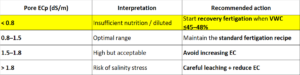
Table 3. Interpretation of Pore-Water ECp and Recommended Actions
Under the high-rainfall conditions of Western Georgia, the most critical scenario in this rule is the yellow-marked case—nutrient leaching after rainfall.
Technical methods for implementing this fertigation algorithm are presented below.
Irrigation and Fertigation Management
For Large-Scale Farms
Large farms require the implementation of fully automated, sensor-based irrigation and fertigation systems to effectively apply the above algorithms.
Such systems include Agronic 2500, Agronic 4500, and Agronic 5500, offered by ProAgro.
AgroBee SDI-12 sensor readers collect data on ECb, VWC %, and substrate temperature from any point in the orchard and simultaneously calculate pore electrical conductivity (ECp).

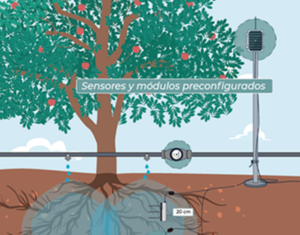
Based on these data, Agronic controllers can:
- Automatically start or stop irrigation and fertigation;
- Switch between different operating modes (e.g., nutrient recovery after rainfall);
- Execute any predefined irrigation and fertigation algorithm.
Other brands available on the local market do not calculate pore EC (ECp) and therefore cannot fully automate blueberry production in pots.
Irrigation and Fertigation Management
For Small-Scale Farms
The above algorithms can also be applied using semi-automatic systems offered by ProAgro, which are affordable for small farms.
ProAgro provides a sensor kit that measures:
- Substrate water content (VWC %),
- Temperature,
- Bulk electrical conductivity of the substrate (ECb).
The kit is affordable for small-scale farms.
The sensor can be easily inserted into any pot using its fork-shaped probes, and readings can be viewed via a mobile application. Based on the measured data (VWC %, ECb, and temperature), ProAgro assists with the calculation of pore electrical conductivity (ECp).
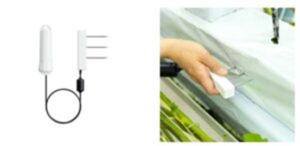
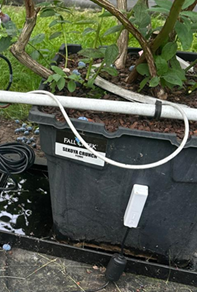
The farmer then follows the sequence of actions described in Tables 2 and 3.
For fertigation, ProAgro offers a three-channel fertigation unit (2 fertilizers + 1 acid) with automatic EC and pH control, suitable and affordable for small farms.
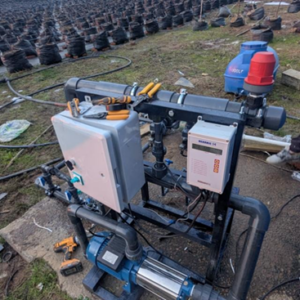
It is important to emphasize that this equipment automatically regulates EC and pH, whereas most other devices on the market only measure and display these values, requiring manual adjustment—which is impractical in real production conditions.