
Weather stations are an important tool for modern agriculture. They provide weather forecasts for a given region, which helps farmers plan agricultural work (mechanical, spraying pesticides, etc.).
There is a so-called virtual weather station service. Large weather forecasting companies have many weather stations in all corners of the world. Including near your area. The data obtained from them is used to model the weather forecast for your location. Such a forecast is quite sufficient for a farmer.
Physical weather stations consist of 5 similar sensors: temperature, relative humidity, solar radiation, wind speed and direction and one flow sensor: a rain sensor. You should pay attention to how high-quality sensors a particular supplier has. You can get a weather forecast with them.
Most weather stations based on these sensors calculate the evapotranspiration coefficient, ETc, which is an indicator of evaporation and transpiration. It depends on temperature, relative humidity and wind speed. Based on this data, it is possible to adjust the irrigation intensity. If your automatic irrigation system receives data from the weather station, it is possible to program a special condition (conditional irrigation), which will be tied to ETc and will increase or decrease the irrigation rate.
In addition, the weather station calculates the vapor pressure deficit (Vapor Pressure Deficit), which shows how close or far the vapor pressure in the air is from the saturation value. Based on this value and the data from the leaf wetness sensor, agronomists discuss the likelihood of the occurrence of certain plant diseases. Some weather stations have software developed by scientific centers. They use these measurements to predict plant diseases. There are weather stations that use artificial intelligence. They make predictions using artificial intelligence.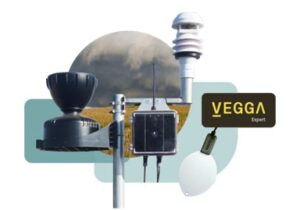
This helps the farmer to carry out preventive spraying against expected diseases
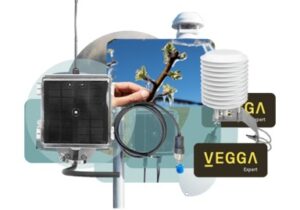
Weather stations help you determine the frost point, that is, to determine the climatic condition that causes freezing of buds and flowers, damage and reduction in yield. It turned out that this point, in addition to temperature, also depends on humidity, vapor pressure deficit. Because of this, frost can occur at plus 1-3 C.
If your weather station system is compatible and connected to an irrigation system, it is possible to create a condition that automatically turns on the anti-freeze system at the frost point. Therefore, when choosing a weather station, pay attention to whether this or that station is integrated with an automatic irrigation system to turn on the anti-freeze sprinkler system (conditional irrigation). Obviously, this is very important because frosts tend to start around midnight and early morning, which can be overlooked by a person.
It is also assumed that your automatic system has the conditional irrigation option turned on.